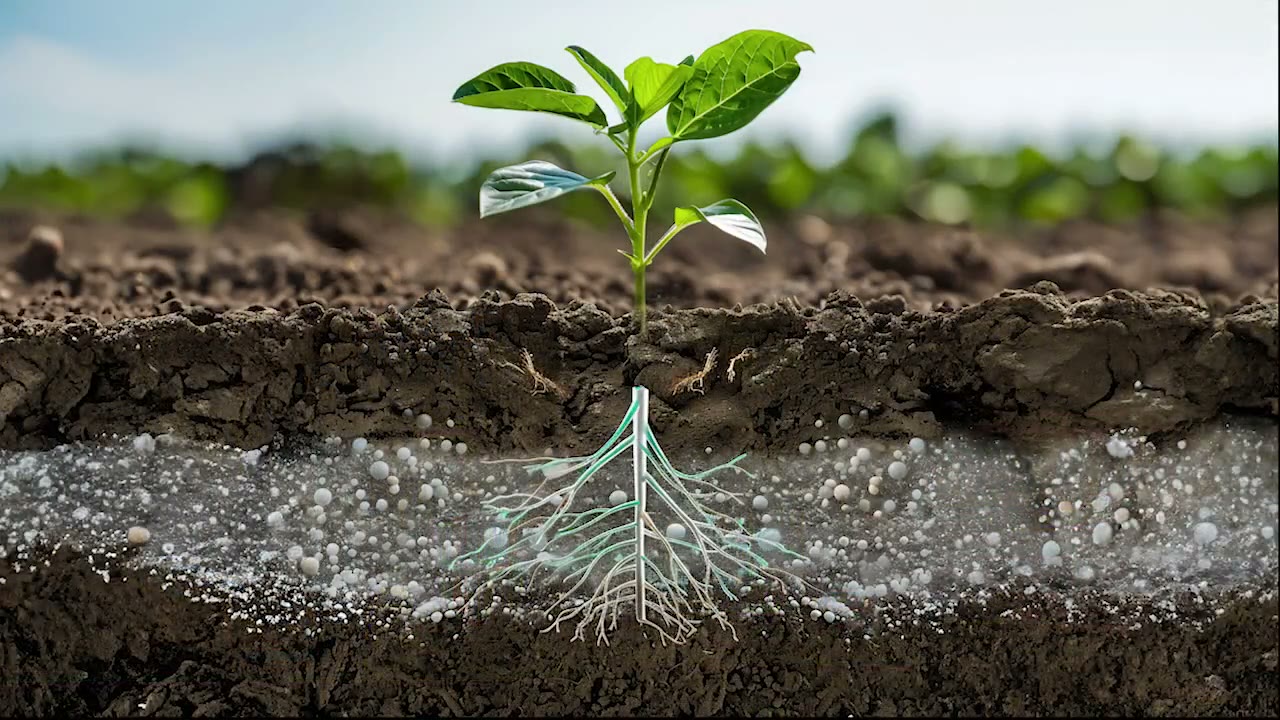
How Nanotern works.
Scroll to follow a seedling below the surface, to the roots and the granules beside them.
In the root zone, each granule is a small water reservoir within reach of the roots.
Nanotern is a superabsorbent polymer, cross-linked into a three-dimensional network that absorbs water and stores it as a gel in the root zone. The granule is the reservoir at depth. Aqua, the liquid form, builds a finer moisture-holding network near the surface.
One application, five stages
The cycle repeats with every rain or irrigation for about 400 days.
Apply
The granule is placed once in the root zone, blended with soil, at sowing, planting or turf laying. It goes down by hand or with the equipment already on site. Water after application to charge the reservoir.
Absorb
At the next rain or irrigation the network takes up water, up to 1,800 times its own weight, together with the nutrients dissolved in it. Those nutrients stay in the root zone instead of draining through.
Store
The gel holds its water against gravity and evaporation, and its structure withstands the pressure of the soil above it.
Release
As the soil dries, the moisture gradient reverses and the granule returns water to the roots gradually, according to the plant's demand and not on a fixed schedule.
Recharge
With the next wetting the granule swells again. One application stays active for about 400 days, and the material then breaks down in the soil.
Granule and Aqua
Two forms for one root zone. They can be used separately or together.
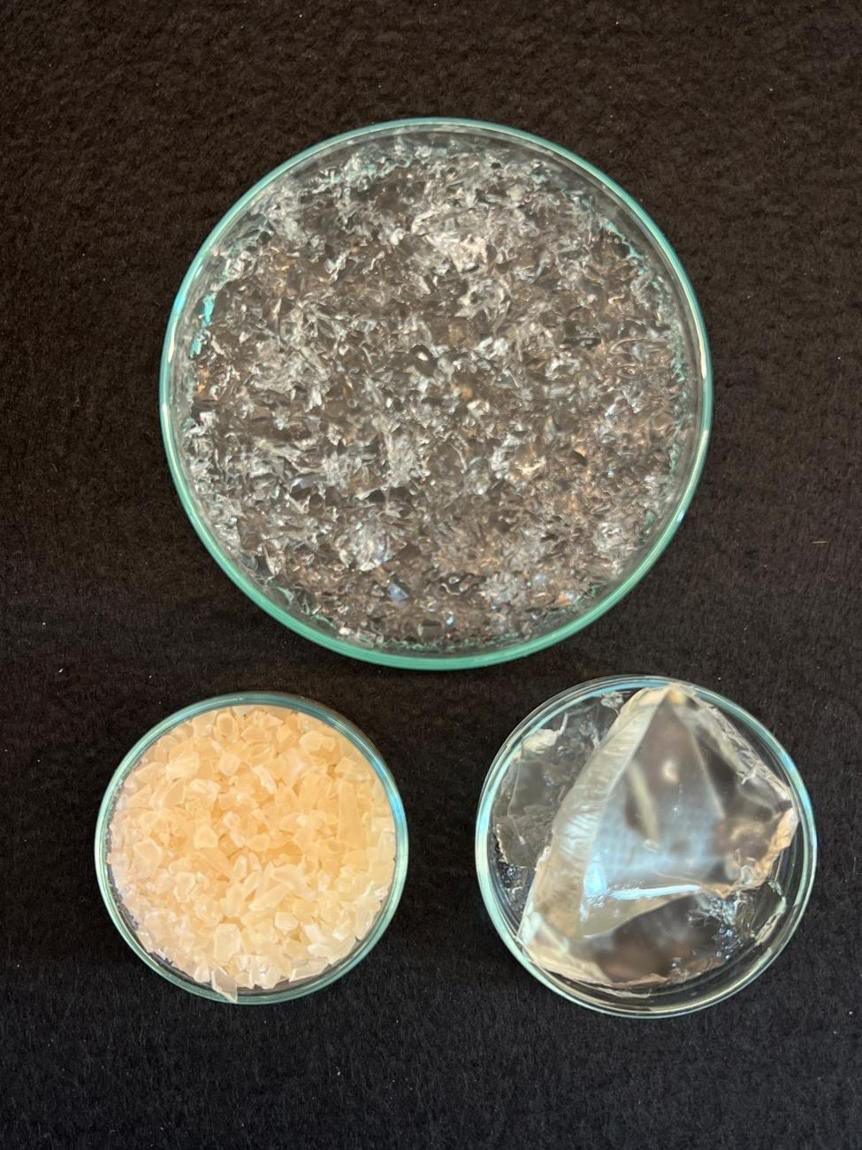
- Granule
- The reservoir at depth. Placed once in the root zone, it stores the bulk of the water and releases it over weeks.
- Aqua
- The liquid form, fed through the irrigation line 6 to 8 times a season. It does not form swelling particles. It forms a thin moisture-retaining network in the upper soil that slows infiltration losses and evaporation.
Illustration of one season, sowing on the left. Not to scale.
What it is made of
Four functional groups in the polymer, each with one task.
The Agriculture and Landscape grades are potassium-based nanocomposite polymers. Bio+ carries the same functional chemistry on a renewable cellulose backbone.
- Rapid water uptake
- Attracts water quickly and fills the reservoir.
- Retention and durability
- Protects the gel under soil pressure.
- Salt-stress resistance
- Keeps its capacity in saline soils and alongside fertiliser.
- Flexibility
- Lets the gel swell and release repeatedly without tearing.
What it is not
- Not a fertiliser
- It holds the nutrients dissolved in the water and adds none of its own.
- Not a plant-protection product
- Nanotern is sold as a soil improver.
- Not a substitute for water
- It stores and returns the water the land receives. It does not create any.
Questions
Which soils and climates is it suited to?
All major soil types: sandy, loamy, clay, silty, peaty and chalky. It is used from arid and semi-arid zones to temperate regions, and the benefit is largest where water is scarce or rainfall is irregular.
Is special equipment needed?
No. Nanotern is applied by hand or with standard planters, spreaders and aerators, and Aqua runs through an existing irrigation line.
Can it be used alongside fertiliser?
Yes. It is compatible with most standard agricultural inputs and keeps dissolved nutrients available in the root zone.
Is it safe for crops, soil and the surrounding ecosystem?
ANT Systems describes Nanotern as biodegradable and non-toxic to plants and soil organisms. Bio+ is the cellulose-based grade for users who want a bio-based material.
How much do I need?
From 3 to 5 g for a seedling to 20 to 100 kg per hectare for fields and turf. The dose table is on the products page, and we set the rate for your site with you.